Clear Your Criminal Record. Reclaim Your Future
Professional South African expungement services starting from R2,500. See if you qualify in 60 seconds
CRIMINAL RECORD expungement services SOUTH AFRICA.
Looking to clear your criminal record and start fresh? Our expungement services can help! Our experienced team is dedicated to helping you navigate the legal process and achieve a clean criminal record. Don't let your past hold you back any longer. Contact us today to learn more about how we can help you move forward with confidence. R2500 ALL-INC

At Criminal Record Expungement Services (Pty) Ltd (CRES) we specialise in the complex legal process of expunging criminal records. Our team of experienced attorneys has the knowledge and expertise to guide you through the process and help you obtain a clean criminal record.
We offer services tailored to your needs, from initial assessments and consultations to legal representation and filing of expungement applications on your behalf. We aim to ensure that you receive the highest quality service and achieve the best possible results in the shortest possible time.
With our assistance, you can rest assured that your case will be handled professionally and efficiently, with the utmost respect for your privacy and confidentiality. We understand the issue's sensitivity and are committed to helping you move forward with your life.
Don't let your criminal record hold you back. Complete our Online Form to learn more about our expungement services and how we can help you clear your record and start afresh.
Click Here- Free No obligation eligibility test
WhatsApp -Message Us
Contact Form - Click
Expungement Process - Learn More
FAQ - Frequently Asked Questions
Benefits of Expungement
WHATSAPP - MESSAGE US!
Contact CRES (Criminal Record Expungement Services)
Contact
- Criminal Record Expungement Services (Pty) Ltd Office 4, Second Floor, Northern Pavilion
Criminal Record Expungement Services (Pty) Ltd is your criminal record expungement legal companion. Our experts can help advise you on how to follow the correct legal procedure and what legal steps you might be able to take to clear your criminal record.
Do I Qualify to expunge my south african criminal record?
Find out if you are eligible for criminal record expungement in South Africa. Learn about the requirements and qualifications needed to have your criminal record expunged. Also check out our Online Eligibility Test below.

Expungement of a criminal record is a process by which a criminal record of a convicted offender is removed from the criminal record database of the Criminal Record Centre of the South African Police Service.
This allows you to carry on with life without a criminal record is an obstruction to employment opportunities.
You can apply to have your criminal record expunged when:
- ten years have passed after the conviction for that offence.
- you have not been convicted and sentenced to a period of imprisonment without the option of a fine during those ten years.
- the sentence was corporal punishment.
- the sentence was postponed, or you were cautioned and discharged.
- the sentence was a fine not exceeding R20 000.
- the sentence was imprisonment with the option to pay a fine (not more than R20 000) instead of serving the period of incarceration.
- the sentence of imprisonment was suspended wholly.
- the sentence was correctional supervision in terms of section 276(1)(h) of the Act.
- the sentence was imprisonment in terms of section 276(1)(i) of the Act.
- the sentence was periodical imprisonment in term of section 276(1)(c) of the Act.
- proof is provided that your name has been removed from the National Register of Sex Offenders or the National Child Protection Register, if relevant.
images criminal record expungements


FREE ONLINE ELIGIBILITY TEST. DO I QUALIFY TO EXPUNGE MY CRIMINAL RECORD?
Check-in one minute if you qualify to expunge your criminal record.
Our Process: How to Clear Your Criminal Record
No Police Clearance? No Problem.
If you are unsure whether you have a criminal record, or if you aren't sure if you qualify for expungement, our streamlined process is designed to give you total clarity within 48 hours.
Step 1: Complete the Online Assessment
Start by filling out our simple online form.
- Already have a report? If you have a copy of your criminal record report (less than 6 months old), upload it via our secure facility. This saves you R500 on your assessment fee.
- Don't have a report? Move to Step 2.
Step 2: Fingerprint Capture (2 Options)
To pull an official record from the SAPS National Criminal Record Centre, a fresh set of fingerprints is required.
- Option A: Visit a Partner (Fastest)Visit one of our 300+ Fingerprint Capture Partners across South Africa. This is a 10-minute walk-in service—no appointment is necessary. It is free to have your fingerprints taken at our partner locations.[View Fingerprint Map]
- Option B: Police Station or International. If you are outside South Africa or not near a partner, you can have your fingerprints taken at any police station. Once done, contact us at info@clear-criminal-record.co.za for courier instructions.
Step 3: Receive Your Report & Legal Assessment
Once your fingerprints are captured, notify us via email. We will electronically retrieve your Criminal Record Report.
- Turnaround Time: Results are typically available within 48 hours (two working days).
- The Assessment: We don't just send you a report; we provide a professional legal assessment confirming if you qualify for expungement, the total costs, and the expected timeframe.
Step 4: Decision & Application
After reviewing your assessment, you can choose to proceed with the full expungement. There is no obligation to continue if you are not ready.
- Fast Lodgement: Once you give us the green light and settle the invoice, we professionally prepare and lodge your application with the Department of Justice within three business days.
Why Choose Our Managed Process?
- Zero Guesswork: We confirm your eligibility before you commit to the full legal process.
- Paperwork Handled: We manage the J744 application from start to finish.
- Secure & Confidential: Your data is protected under POPIA-compliant protocols.
CRIMINAL RECORD EXPUNGEMENT SERVICES PTY LTD
Office 5, Second Floor, Northern Pavilion (Gate 12) Loftus Versveld, 416 Kirkness Street, Arcadia, Pretoria, Gauteng Province, South Africa
Tel: 087 0010 733
E-mail: info@clear-criminal-record.co.za
https://www.clear-criminal-record.co.za/
Check out the Benefits of Expunging Your Criminal Record
Expunging your criminal record can significantly alter your life trajectory, offering a fresh start in various aspects. Here's an in-depth look at why you might consider this legal process:

1. Enhanced Job Prospects
- Background Checks: Employers often conduct background checks, and a criminal record can be a significant barrier to employment. Even minor offences can lead to rejection, as many employers view any criminal history as a risk. Expungement removes this record, making you a more viable candidate.
- Career Advancement: Not only does it help in getting a job, but it also aids in career progression. Without a criminal record, you're more likely to be considered for promotions or higher-level positions that might otherwise be off-limits.
2. Travel Opportunities
- International Travel: Many countries have strict entry policies regarding criminal records. An expunged record can simplify travel, reducing the risk of visa denials or complications at borders. A clear criminal record is particularly crucial for those who travel frequently or wish to relocate internationally.
3. Personal Growth and Social Acceptance
- Housing: Landlords often perform background checks. An expunged record can make renting or buying a home much easier, as it removes one of the significant hurdles in housing applications.
- Insurance: Some insurance companies might charge higher premiums or deny coverage based on criminal history. Expungement could lower these costs or make you eligible for standard rates.
- Education: Certain educational programs or scholarships might be inaccessible to people with criminal records. Clearing your record can open doors to further education or training opportunities.
- Moving On: As you mature, your past mistakes should not define your future. Expungement symbolises a legal recognition of your rehabilitation, which can be psychologically liberating. It's a step towards self-improvement and acceptance back into society without the stigma of a criminal record.
- Social and Community Involvement: Without a record, you can engage more freely in community activities, volunteer work, or even run for public office in some jurisdictions, where a clean record might be a prerequisite.
4. Legal and Financial Benefits
5. Peace of Mind
- Mental Health: Constantly worrying about how your record might affect your life can be mentally taxing. Expungement offers peace of mind, reducing anxiety about future repercussions.
The Process of Expungement
- Eligibility: Not all records can be expunged; eligibility varies by jurisdiction and the nature of the crime. Generally, misdemeanors and certain felonies can be expunged after a waiting period and good behavior.
- Legal Assistance: Given the complexities, consulting with an expert specialising in expungements can help you navigate legal requirements and processes effectively.
- Time and Cost: The process can take time and involve fees, but the long-term benefits often outweigh these initial costs.
Expunging your criminal record isn't just about erasing the past; it's about unlocking your future. Whether it's for career advancement, personal travel, or simply peace of mind, the benefits of a clean slate can transform your life, offering opportunities that might have seemed out of reach. If you're considering this step, understanding how it can positively impact your life is crucial.
Already have Police Clearance Report - Upload for Free Assessment
I'd like to UPLOAD you my recent criminal report or Police Clearance for you to assess if I quilify to expunge my criminal record.
Upload your Criminal Record Report for a free assessment if you qualify to expunge your criminal record.
Check if you qualify to expunge your South African criminal record?
Find out if you are eligible for criminal record expungement in South Africa. Learn about the requirements and qualifications needed to have your criminal record expunged. Also check out our Online Eligibility Test below.
You can apply for expungement of your criminal record in terms of the Criminal Procedure Act, 1977, to the Director-General: Department of Justice and Constitutional Development.
Expungement of a criminal record is a process by which a criminal record of a convicted offender is removed from the criminal record database of the Criminal Record Centre of the South African Police Service.
This allows you to carry on with life without a criminal record is an obstruction to employment opportunities.
You can apply to have your criminal record expunged when:
- ten years have passed after the conviction for that offence.
- you have not been convicted and sentenced to a period of imprisonment without the option of a fine during those ten years.
- the sentence was corporal punishment.
- the sentence was postponed, or you were cautioned and discharged.
- the sentence was a fine not exceeding R20 000.
- the sentence was imprisonment with the option to pay a fine (not more than R20 000) instead of serving the period of incarceration.
- the sentence of imprisonment was suspended wholly.
- the sentence was correctional supervision in terms of section 276(1)(h) of the Act.
- the sentence was imprisonment in terms of section 276(1)(i) of the Act.
- the sentence was periodical imprisonment in term of section 276(1)(c) of the Act.
- proof is provided that your name has been removed from the National Register of Sex Offenders or the National Child Protection Register, if relevant.
Click Here - Online Eligibility Check - Check if you can have your criminal record expunged within one minute.
Most popular reasons to EXPUNGE criminal record
Learn about the benefits of criminal record expungement on your career prospects and quality of life. .

Job hunting with a record
Job hunting without a record is hard enough in today’s economy. Having a record makes this process so much harder. Before a potential employee hires a candidate, it is common to run a background check. The nature of your crime is very much taken into consideration and will affect your job prospects.
Travelling with a record
Whether you want to go on holiday or attend a wedding, you must look into the policies of the country you want to go to as each country differs on whether or not they allow people with a criminal record to enter the country.
You have moved on with your life
Finally older and wiser, no longer under the wrong influences. You are finally ready to move on with your life and need to be freed from the unwise life choices of your past.
Complete Online Application Form to Get Started.
It's Time!
To Free Yourself from your Past EXPUNGE Your Criminal Record.
When will you not qualify for an expungement?

- 10 years have not passed after the date of the conviction for that offence
- you were condemned for a sexual offence against a child or a mentally challenged person.
- your name appears in the National Register for sex offenders or the National Child Protection Register.
- your fine is over R20,000.00; and
- you have been incarcerated for a serious crime without the option of a fine.
Complete the Online Application Form to Get Started.
Which option best matches your criminal record situation?
Different Scenarios and the way forward.
CONVICTED
I was convicted (found or pleaded guilty) in court before a magistrate/judge. Click to Check Eligibility to Expunge
Learn MoreMULTIPLE CONVICTIONS
I have multiple convictions. Multiple convictions may be expunged simultaneously.
Learn MoreCASE WITHDRAWN
I was arrested, but the charges have been dropped. When you're arrested, your criminal record is marked with a "case awaiting trial" designation.
Learn MoreAbout CRIMINAL RECORD EXPUNGEMENT SERVICES PTY LTD
Are you ready to wipe the slate clean? Clear your record and regain control of your life.

Your fresh start begins here! 🌈 #CriminalRecordExpungement #SecondChance #NewBeginnings
Contact Criminal Record Expungement Services
Contact our Criminal Record Expungement Division
- Criminal Record Expungement Services (Pty) Ltd Office 4, Second Floor, Northern Pavilion
- +27-012 8836843
- info@clear-criminal-record.co.za
- Mon-Fri - 08:00-19:00
Why Choose Us for Your Criminal Record Expungement?
If you have a criminal record in South Africa, you may be eligible to apply for expungement, which means that your record will be cleared and you will be able to enjoy the benefits of a clean slate. Expungement can open up new opportunities for you, such as employment, education, travel, and more. However, applying for expungement is not a simple or quick process. It involves several steps, such as obtaining a clearance certificate, filling out forms, submitting documents, and following up with the authorities. Depending on your case, the process can take anywhere from 4 - 6 months. That’s why you need a reliable and professional service provider to assist you with your expungement application. At Criminal Record Expungement Services Pty Ltd, we offer a comprehensive and hassle-free service that covers the entire process from start to finish. Unlike our competitors, who only handle the initial submission and leave you to deal with the rest, we take care of everything for you, including:
- Checking your eligibility for expungement and advising you on the best course of action
- Obtaining your clearance certificate from the South African Police Service (SAPS) Criminal Record Centre (CRC)
- Preparing and submitting your expungement application by hand at the Department of Justice (DOJ)
- Following up in person with the DOJ and the CRC for the removal of your criminal record from the database and the issuance of a confirmation letter
- Keeping you updated on the progress and status of your application throughout the process
- Delivering your confirmation letter to you once your expungement is granted
We understand that expungement is a sensitive and personal matter, and we treat every client with respect and confidentiality. We also guarantee that our service is fast, efficient, and affordable. Our fee is only R2,500, which is a small investment compared to the benefits of having a clean record. Our competitor charges a few hundred Rands less, but they only provide a partial service that leaves you with the burden of dealing with the authorities on your own. This can be time-consuming, frustrating, and risky, as you may encounter delays, errors, or rejections. With our service, you can rest assured that your expungement application is in good hands, and that you will receive the best possible outcome. Don’t let your past hold you back from your future.
Contact us today and let us help you expunge your criminal record and start a new chapter in your life.
OUR TEAM IS HERE TO ANSWER YOUR CRIMINAL RECORD EXPUGEMENT QUESTIONS
CONTACT US TODAY AND WE WILL REPLY WITHIN 24 HOURS
Criminal record expungement - F.A.Q
Undeniably, the laws regarding expungement in South Africa can be complex and difficult to understand. At Criminal Record Expungement Services our objective is to offer a comprehensive source for information about criminal record expungement in South Africa. As you explore our website, you will discover an abundance of information regarding expungement, including its definition, the process involved, and whether your specific circumstances are eligible for expungement.
I am not sure if I have criminal record. Can you assist?
Complete our online form and upload your criminal record report to get started. If you need a copy, we can assist you in obtaining one. To do so, you'll need to visit one of our 300+ fingerprint capture partners located throughout South Africa.
This is necessary because criminal record checks require a recent copy of your fingerprints, and capturing them is a 10-minute, walk-in free service. If you're not in South Africa or don't reside near one of our partners, contact us for further information.
Once we have your criminal record report, we will assess if you qualify to have your record expunged and notify you of your options, costs, and time frames to remove the record. If you choose to proceed, we will professionally prepare and lodge an application for expungement within three business days after receipt of the necessary documentation. You'll need to pay our invoice for the expungement application.
If we receive a Criminal Record Report with an adverse listing, we will assess whether you qualify to have your criminal record expunged and provide you with your options, costs, and time frames to remove the record. You may then choose to proceed, but you have no obligation to do so.
At Criminal Record Expungement Services, we are committed to helping you navigate the process of expunging your criminal record. For more information, please visit our informative website or contact us via email or telephone.
I have a criminal record but I am unsure of the details. Can you assist?
Complete our online form and upload your criminal record report to get started. If you need a copy, we can assist you in obtaining one. To do so, you'll need to visit one of our 300+ fingerprint capture partners located throughout South Africa.
This is necessary because criminal record checks require a recent copy of your fingerprints, and capturing them is a 10-minute, walk-in free service. If you're not in South Africa or don't reside near one of our partners, contact us for further information.
Once we have your criminal record report, we will assess if you qualify to have your record expunged and notify you of your options, costs, and time frames to remove the record. If you choose to proceed, we will professionally prepare and lodge an application for expungement within three business days after receipt of the necessary documentation. You'll need to pay our invoice for the expungement application.
If we receive a Criminal Record Report with an adverse listing, we will assess whether you qualify to have your criminal record expunged and provide you with your options, costs, and time frames to remove the record. You may then choose to proceed, but you have no obligation to do so.
At Criminal Record Expungement Services, we are committed to helping you navigate the process of expunging your criminal record. For more information, please visit our informative website or contact us via email or telephone.
I have a criminal record. Do I qualify to remove/expunge it.?
- ten years have passed after the conviction for that offence.
- you have not been convicted and sentenced to a period of imprisonment without the option of a fine during those ten years.
- the sentence was corporal punishment.
- the sentence was postponed, or you were cautioned and discharged.
- the sentence was a fine not exceeding R20 000.
- the sentence was imprisonment with the option to pay a fine (not more than R20 000) instead of serving the period of incarceration.
- the sentence of imprisonment was suspended wholly.
- the sentence was correctional supervision in terms of section 276(1)(h) of the Act.
- the sentence was imprisonment in terms of section 276(1)(i) of the Act.
- the sentence was periodical imprisonment in term of section 276(1)(c) of the Act.
- proof is provided that your name has been removed from the National Register of Sex Offenders or the National Child Protection Register, if relevant.
What will it cost to expunge my criminal record?
How long will it take to remove my criminal record?
I have a copy of my police report. Can you check if I qualify to expunge my criminal record?
Click Here
I have multiple convictions. Do I still qualify to expunge my criminal record?
Is it Legal to expunge a criminal record?
Under the new law, individuals convicted of a minor offence, as determined by the type of sentence imposed 10 or more years ago, may qualify for expungement without needing a Presidential Pardon. The sentence must have been a suspended jail term, correctional supervision, or a fine that did not exceed R20,000.
This means that professional service providers can legally remove your criminal record through an administrative process with the Department of Justice based on specific criteria. The option for a Presidential Pardon application still exists for all criminal convictions that do not meet the standard 10-year expungement criteria.
Why should I use a professional service provider to expunge my criminal record?
Professional service providers are well-versed in the legal process of expunging criminal records and have a wealth of experience in dealing with the intricacies involved. They can guide you through the process, from determining whether or not you are eligible to have your record expunged to preparing and filing the necessary paperwork.
By entrusting your expungement to a professional, you can save yourself time and money in the long run. The process of expunging a criminal record can be lengthy and complex, and mistakes can result in months of delays or even a denial of your request. A professional service provider can ensure that the process is done the first time correctly, avoiding unnecessary delays and increasing your chances of success.
Moreover, having a criminal record can significantly limit your employment and educational opportunities and your ability to secure housing and loans. By expunging your record, you can improve your chances of obtaining gainful employment, advancing your education, and securing better housing and financing options.
In conclusion, utilising the services of a professional expungement service provider can save you time, money, and hassle while increasing your chances of success. So, if you are considering expunging your criminal record, it is highly recommended that you seek the assistance of a professional service provider.
When can a criminal record be expunged.
- Ten years have passed since the date of your criminal conviction
- You have not been convicted of any other offences and sentenced to a period of imprisonment without the option of a fine during the ten years since your original conviction.
- The fine imposed for the conviction did not exceed R20,000.
- You were not convicted of a sexual offence against a child or a person who is mentally disabled, and your name is not registered in the National Register for Sex Offenders.
- You were not found unsuitable to work with children by a criminal court, and your name is not included in the National Child Protection Register.
- You were not convicted of a crime on the base of race.
- You were convicted of an offence which would not be regarded as an offence in an open and democratic society based on human dignity equality and freedom under the democratic constitutional dispensation.
What is an Expungement?
What does it mean to have your criminal record expunged?
What is the expungement of a criminal record?
• This allows a person to carry on with life without a criminal record being an obstruction to employment opportunities or a source of discrimination.
• An expunged record does not exist, which means you don’t need to declare it.
• Arrests are not recorded, only convictions for the purposes of a criminal record.
• Paying an admission of guilt fine also counts as a conviction,
What is schedule 1 offences.
2. Fraud, extortion, forgery and uttering or an offence referred to in the Prevention and Combating of Corrupt Activities Act, 2004 (Act 12 of 2004), where the amount involved does not exceed R1 500.
3. Malicious injury to property, where the amount involved does not exceed R1 500.
4. Common assault where grievous bodily harm has not been inflicted.
5. Perjury.
6. Contempt of court.
7. Blasphemy.
8. Compounding.
9. Crimen injuria.
10. Defamation.
11. Trespass.
12. Public Indecency.
13. Engaging sexual services of persons 18 years or older, referred to in section 11 of the Criminal Law (Sexual Offences and Related Matters) Amendment Act, 2007 (Act 32 of 2007).
14. Bestiality, referred to in section 13 of the Criminal Law (Sexual Offences and Related Matters) Amendment Act, 2007.
15. Acts of consensual sexual penetration with certain children (statutory rape) and acts of consensual sexual violation with certain children (statutory sexual assault), referred to in and subject to sections 15 and 16 of the Criminal Law (Sexual Offences and Related Matters) Amendment Act, 2007, respectively.
16. Any offence under any law relating to the illicit possession of dependence producing drugs, other than any offence referred to in Item 17 of this Schedule, where the quantity involved does not exceed R500 in value.
17. Any other statutory offence where the maximum penalty determined by that statute is imprisonment for a period of no longer than three months or a fine for that period, calculated in accordance with the Adjustment of Fines Act, 1991 (Act 101 of 1991).
18. Any conspiracy, incitement or attempt to commit any offence referred to in this Schedule.
What are Schedule 2 offences.
2. Fraud, extortion, forgery and uttering or an offence referred to in the Prevention and Combating of Corrupt Activities Act, 2004 (Act 12 of 2004), where the amount involved exceeds R1 500.
3. Robbery, other than robbery with aggravating circumstances.
4. Malicious injury to property, where the amount involved exceeds R1 500.
5. Assault, involving the infliction of grievous bodily harm.
6. Public violence.
7. Culpable homicide.
8. Arson.
9. Housebreaking, whether under the common law or a statutory provision, with the intent to commit an offence.
10. Administering poisonous or noxious substance.
11. Crimen expositionis infantis (child abandonment).
12. Abduction.
13. Sexual assault, compelled sexual assault or compelled self-sexual assault referred to in sections 5, 6 and 7 of the Criminal Law (Sexual Offences and Related Matters) Amendment Act, 2007 (Act 32 of 2007), respectively, where grievous bodily harm has not been inflicted.
14. Compelling or causing persons 18 years or older to witness sexual offences, sexual acts or self-masturbation, referred to in section 8 of the Criminal Law (Sexual Offences and Related Matters) Amendment Act, 2007.
15. Exposure or display of or causing exposure or display of child pornography or pornography as referred to in sections 10 or 19 of the Criminal Law (Sexual Offences and Related Matters) Amendment Act, 2007, respectively.
16. Incest and sexual acts with a corpse, referred to in sections 12 and 14 of the Criminal Law (Sexual Offences and Related Matters) Amendment Act, 2007, respectively.
17. Exposure or display of or causing exposure or display of genital organs, anus or female breasts to any person ('flashing'), referred to in sections 9 or 22 of the Criminal Law (Sexual Offences and Related Matters) Amendment Act, 2007.
18. Violating a dead body or grave.
19. Defeating or obstructing the course of justice.
20. Any offence referred to in section 1 or 1A of the Intimidation Act, 1982 (Act 72 of 1982).
21. Any offence relating to criminal gang activities referred to in Chapter 4 of the Prevention of Organised Crime Act, 1998 (Act 121 of 1998).
22. Any contravention of section 2 of the Animals Protection Act, 1962 (Act 71 of 1962).
23. Any offence under any law relating to the illicit possession of dependence producing drugs, other than any offence referred to in Item 24 of this Schedule, where the quantity involved exceeds R500 but does not exceed R5 000 in value.
24. Any other statutory offence where the maximum penalty determined by that statute is imprisonment for a period exceeding three months but less than five years or a fine for that period, calculated in accordance with the Adjustment of Fines Act, 1991 (Act 101 of 1991).
25. Any conspiracy, incitement or attempt to commit any offence referred to in this Schedule.
What is schedule 3 offences.
2. Sedition.
3. Murder.
4. Extortion, where there are aggravating circumstances present.
5. Kidnapping.
6. Robbery - (a) where there are aggravating circumstances; or (b) involving the taking of a motor vehicle.
7. Rape or compelled rape referred to in sections 3 and 4 of the Criminal Law (Sexual Offences and Related Matters) Amendment Act, 2007 (Act No. 32 of 2007), respectively.
8. Sexual assault, compelled sexual assault or compelled self-sexual assault referred to in sections 5, 6 and 7 of the Criminal Law (Sexual Offences and Related Matters) Amendment Act, 2007, respectively, involving the infliction of grievous bodily harm.
9. Sexual exploitation of children, sexual grooming of children and using children for or benefiting from child pornography, referred to in sections 17, 18 and 20 of the ACJR FACTSHEET – EXPUNGEMENT OF RECORD - CHILD 6 FACTSHEET 4 Criminal Law (Sexual Offences and Related Matters) Amendment Act, 2007, respectively.
10. Exposure or display of or causing exposure or display of child pornography or pornography to children referred to in section 19 of the Criminal Law (Sexual Offences and Related Matters) Amendment Act, 2007, if that exposure or display is intended to facilitate or promote— (a) the sexual exploitation or sexual grooming of a child referred to in section 17 or 18 of the Criminal Law (Sexual Offences and Related Matters) Amendment Act, 2007, respectively; or (b) the use of a child for purposes of child pornography or in order to benefit in any manner from child pornography, as provided for in section 20 of the Criminal Law (Sexual Offences and Related Matters) Amendment Act, 2007.
11. Compelling or causing children to witness sexual offences, sexual acts or self-masturbation referred to in section 21 of the Criminal Law (Sexual Offences and Related Matters) Amendment Act, 2007. 12. Sexual exploitation of persons who are mentally disabled, sexual grooming of persons who are mentally disabled, exposure or display of or causing exposure or display of child pornography or pornography to persons who are mentally disabled or using persons who are mentally disabled for pornographic purposes or benefiting therefrom, referred to in sections 23, 24, 25, and 26 of the Criminal Law (Sexual Offences and Related Matters) Amendment Act, 2007, respectively.
13. Trafficking in persons for sexual purposes referred to in section 71(1) and involvement in trafficking in persons for sexual purposes referred to in section 71(2) of the Criminal Law (Sexual Offences and Related Matters) Amendment Act, 2007.
14. Any offence referred to in Parts 1, 2 and 3 of Chapter 2 of the Protection of Constitutional Democracy against Terrorist and Related Activities Act, 2004 (Act No. 33 of 2004).
15. Any offence relating to - (a) racketeering activities referred to in Chapter 2; or (b) the proceeds of unlawful activities referred to in Chapter 3, of the Prevention of Organised Crime Act, 1998 (Act No. 121 of 1998).
16. The crimes of genocide, crimes against humanity and war crimes referred to in the Implementation of the Rome Statute of the International Criminal Court Act, 2002 (Act No. 27 of 2002).
17. Any offence under any law relating to— (a) the dealing in or smuggling of ammunition, firearms, explosives or armament; (b) the possession of firearms, explosives or armament.
18. Any offence referred to in section 13(f) of the Drugs and Drug Trafficking Act, 1992 (Act No. 140 of 1992).
19. Any offence of a serious nature if it is alleged that the offence was committed by a person, group of persons, syndicate or any enterprise, acting in the execution or furtherance of a common purpose or conspiracy.
20. Any offence under any law relating to the illicit possession of dependence producing drugs, other than an offence referred to in Item 21 of this Schedule, where the quantity involved exceeds R5 000 in value.
21. Any other statutory offence where the maximum penalty determined by that statute is imprisonment for a period exceeding five years or a fine for that period, calculated in accordance with the Adjustment of Fines Act, 1991 (Act No. 101 of 1991).
22. Any conspiracy, incitement or attempt to commit any offence referred to in this Schedule.
Does a criminal record automatically expire in South Africa?
Can I do it myself.
Eligibility Criteria
To qualify for expungement in South Africa, certain criteria must be met:
- Time Passed: Generally, a specific period must have elapsed since the conviction or completion of the sentence.
- Nature of Offense: Certain offenses may not be eligible for expungement, especially serious crimes or those involving violence.
- Clean Record: Applicants must demonstrate good behavior and a clean record since the conviction.
Step 1: Obtain the Necessary Forms
Applicants must obtain the relevant forms from the Department of Justice or the South African Police Service (SAPS). These forms typically include personal details, details of the conviction, and any relevant supporting documents.
Step 2: Complete the Forms
Applicants must accurately complete all sections of the forms, providing truthful information about the conviction and any subsequent conduct.
Step 3: Submit the Application
Once the forms are completed, applicants must submit them to the relevant authorities along with any required supporting documents, such as identification and proof of rehabilitation.
Step 4: Await Review
The application will undergo review by the authorities to determine eligibility for expungement. This process may take some time, depending on the workload of the reviewing agency.
Step 5: Receive Decision
Upon review, applicants will receive a decision regarding their expungement application. If approved, the criminal record will be cleared or sealed, allowing the individual to move forward without the stigma of past convictions.
What are some common reasons for denied expungement applications submitted in person? ?
- Ineligibility:
- If the applicant does not meet the eligibility criteria, such as the required waiting period (usually 10 years) since the conviction.
- If the applicant has been convicted and sentenced to imprisonment without the option of a fine during the waiting period.
- Incomplete Applications:
- If the application form is not properly completed or lacks necessary information.
- Missing supporting documents or evidence required for the expungement process.
- Pending Legal Proceedings:
- If there are ongoing legal proceedings related to the offense or conviction.
- Expungement applications are generally not considered while legal matters are unresolved.
- Multiple Convictions:
- If the applicant has multiple convictions within the waiting period.
- Expungement may be denied if there are other recent convictions.
- Serious Offenses:
- Certain serious offenses may not be eligible for expungement.
- Crimes involving violence, sexual offenses, or crimes against children may be excluded.
- Incorrect Procedure:
- If the application is not submitted to the correct authority (e.g., Department of Justice and Constitutional Development).
- Failure to follow the prescribed procedure for expungement.
- Lack of Evidence:
- If the applicant cannot provide sufficient evidence to support their case.
- Evidence of rehabilitation or changed circumstances may be necessary.
- Non-Compliance with Waiting Period:
- If the applicant applies before the required waiting period has elapsed.
- Expungement applications must align with the specified time frame.
- Failure to Follow Up:
- If the applicant does not follow up on their application or respond to inquiries promptly.
- Delays in responding can affect the completion of the process.
- Errors in Documentation:
- If there are errors or discrepancies in the submitted documents.
- Incorrect information or inconsistencies can lead to denial.
Is professional assistance necessary for the expungement process?
Can I apply to expunge apartheid-era records?
How does expungement benefit individuals?
Do You Qualify for Expungement of your South-African Criminal Record?
- Time Lapse: At least 10 years must have passed since the date of your conviction.
- Clean Record: You should not have any other convictions during this period, nor should you have been sentenced to imprisonment without the option of a fine.
- Original Sentence: Your original sentence should fall into one of the following categories:
- Corporal punishment
- Postponement
- Caution and discharge
- A fine of less than R20,000
- Imprisonment with the option of a fine of less than R20,000
- A wholly suspended sentence
- Correctional supervision under section 276(1)(h) of the Criminal Procedure Act (with no prison time served)
- Periodical imprisonment under section 276(1)© of the Criminal Procedure Act
- Imprisonment under section 276(1)(i) of the Criminal Procedure Act (where one-sixth of the sentence was served in prison)
Expungement of a criminal record allows you to move forward without the burden of a criminal history affecting employment opportunities and other aspects of life
Do I have to disclose an expunged criminal record to a future employer?
Legal Framework: The process of expungement, as defined by the Criminal Procedure Act, 1977, allows for the removal of a criminal conviction from the national criminal record database under certain conditions. Once a record is expunged, legally, it's as if the conviction never happened for most practical purposes.
Employer's Right to Know: While employers can conduct background checks, an expunged record should not appear in these checks. Therefore, legally, you are not required to disclose an expunged conviction because, in the eyes of the law, it no longer exists on your record.
Practical Application: However, honesty in employment applications is generally valued, and while not legally required to disclose an expunged record, how this plays out in practice might vary. Some employers might appreciate transparency, but legally, you stand on firm ground by not disclosing an expunged conviction.
If your criminal record has been legally expunged in South Africa, you are not under an obligation to disclose this to a prospective employer. This aligns with the intent of expungement laws, which aim to remove barriers to employment and reintegration into society.
Can I expunge a record if it’s been less than 10 years?
Does a criminal record ever fall away automatically?
How long does the process take?
Issuing certificate of CRIMINAL RECORD expungement
• If the Director-General of Justice and Constitutional Development is satisfied that you or the child being applied for meet the requirements set out in the Criminal Procedure Act, he/she will instruct the SAPS Record Centre to issue a letter of expungement directing that your conviction and sentence be expunged. This process takes approximately three months. The SAPS record centre will then remove/expunge the criminal record from the database and issue the letter submit within 14 working days after being directed by the Department of Justice to do so. The process usually takes three to four months to complete.
How do I remove or expunge my criminal record?
Expungement of a Criminal Record in terms of the Criminal Procedure Act, 1977 (Act 51 of 1977).


You can apply for expungement of your criminal record in terms of the Criminal Procedure Act, 1977, to the Director-General: Department of Justice and Constitutional Development.
Expungement of a criminal record is a process by which a criminal record of a convicted offender is removed from the criminal record database of the Criminal Record Centre of the South African Police Service.
This allows you to carry on with life without a criminal record being an obstruction to employment opportunities.
You can apply to have your criminal record expunged when:
- a period of 10 years has passed after the date of the conviction for that offence.
- you have not been convicted and sentenced to a period of imprisonment without the option of a fine during those 10 years.
- the sentence was corporal punishment.
- the sentence was postponed or you were cautioned and discharged.
- the sentence was a fine not exceeding R20 000.
- the sentence was imprisonment with the option to pay a fine (not more than R20 000) instead of serving the period of imprisonment.
- the sentence of imprisonment was suspended wholly.
- the sentence was correctional supervision in terms of section 276(1)(h) of the Act.
- the sentence was imprisonment in terms of section 276(1)(i) of the Act.
- the sentence was periodical imprisonment in term of section 276(1)(c) of the Act.
- proof is provided that your name has been removed from the National Register of Sex Offenders or the National Child Protection Register, if relevant.
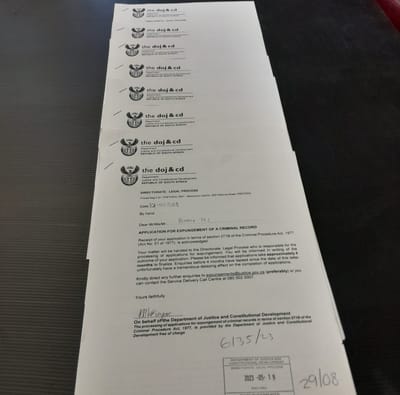
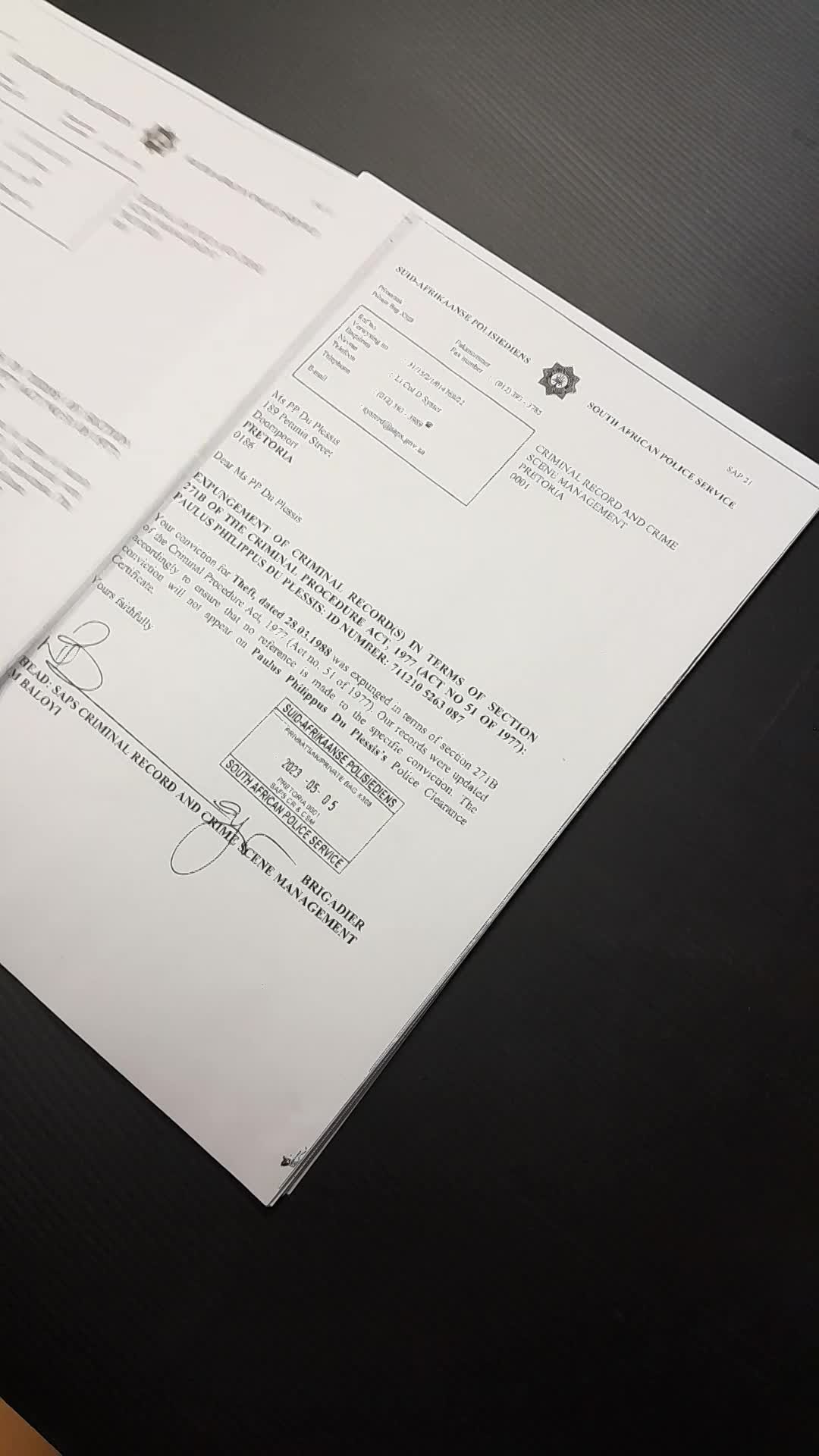
SAMPLE criminal RECORD expungement letter - SAPS Criminal Record Centre
Example letter of an expungement of criminal record facilitated through our offices.

Can you CHECK a criminal record without fingerprints South Africa?
In South Africa, it is mandatory to conduct criminal record checks by using a digital capture of fingerprints. This process involves the use of an Automated Fingerprint Identification System (AFIS), which captures fingerprints and verifies them electronically against the database of the South African Police Service (SAPS). Therefore, having a criminal record in South Africa without fingerprints on file with the SAPS is impossible.
COVID-19 : Expungement of criminal records for persons who paid admission of guilt fines
President Cyril Ramaphosa recently assented to the Judicial Matters Amendment Act, 2023, a piece of legislation that marks a significant turning point for thousands of South Africans currently burdened by minor criminal records
President Cyril Ramaphosa recently assented to the Judicial Matters Amendment Act, 2023, a piece of legislation that marks a significant turning point for thousands of South Africans currently burdened by minor criminal records. While many amendments in this Act address technical and practical changes to existing laws, several provisions offer a profound "fresh start" for individuals who previously believed their records were permanent.
Relief for COVID-19 Regulation
ViolationsOne of the most impactful changes introduced by the 2023 Act is the provision for the expungement of criminal records for persons who paid admission of guilt fines for violating State of Disaster Regulations during the COVID-19 pandemic. During the National State of Disaster, thousands of citizens were arrested or fined for minor infractions. According to the sources, these admissions of guilt previously resulted in a criminal record that could obstruct employment and travel opportunities. The new Act recognises the unique circumstances of that period, allowing these specific records to be cleared.

New Powers Regarding Admission of Guilt Fines
The Act also introduces a forward-looking mechanism to prevent minor offences from staining a person's record in the future. The Minister of Justice and Constitutional Development is now empowered, after due consultation, to determine certain categories of offences where paying an admission of guilt fine will not result in a criminal record at all.
Crucially for those with existing records, the sources state that once the Minister has identified these categories, individuals who already have a criminal record for those identified offences will have them expunged. This shift aims to make the justice system more responsive and ensures that minor infractions do not lead to the long-term social and economic exclusion often associated with a criminal history.
How Professional Assistance Navigates These Changes
While these legislative updates are a major victory for justice, the sources emphasise that the administrative process for expungement remains complex and potentially time-consuming. Applications typically require hand-delivery to the Department of Justice and can take several months to finalise.
At Criminal Record Expungement Services (Pty) Ltd (CRES), we are uniquely equipped to help you benefit from these recent changes. As a firm owned and managed by a practising attorney with over 25 years of experience, we provide the legal expertise necessary to ensure your application aligns with the new 2023 criteria. We assist through the entire journey—from obtaining your clearance certificate to following up in person with the authorities—ensuring you achieve a clean slate as efficiently as possible.
Don't let a minor mistake from the past define your future; the law has changed, and we are here to help you claim the relief you deserve.
A Fresh Start: How New Laws Are Changing the "Admission of Guilt" Trap
For years, many South Africans have fallen into a common legal trap: paying a small "admission of guilt" fine at a police station to avoid a court appearance, only to discover later that they now have a permanent criminal record
For years, many South Africans have fallen into a common legal trap: paying a small "admission of guilt" fine at a police station to avoid a court appearance, only to discover later that they now have a permanent criminal record. This "silent conviction" has historically led to long-term social and economic exclusion, blocking individuals from job opportunities and travel.
However, the legal landscape has shifted. On 3 April 2024, President Cyril Ramaphosa assented to the Judicial Matters Amendment Act, 2023, which introduces significant changes to how minor offences and admission of guilt fines are handled.
New Powers to Protect Your Future
Under this new Act, the Minister of Justice and Constitutional Development has been granted a powerful "forward-looking" mechanism. After due consultation, the Minister can now determine specific categories of offences where paying an admission of guilt fine will not result in a criminal record at all.
This is a major victory for justice and common sense. It ensures that minor infractions—the kind of mistakes that shouldn't define a person's life—do not lead to a "dark cloud" of a criminal record that hinders future employment.
Relief for Existing Records
Crucially, this law isn't just for the future; it offers hope for those already struggling with the stigma of a past conviction. The sources state that once the Minister identifies these specific categories of offences, individuals who already have a criminal record for those offences will have them expunged.
This shift aims to make the South African justice system more responsive to the reality that minor mistakes should not result in lifelong professional "staining".
Immediate Relief: COVID-19 Regulation Fines
One of the most notable immediate changes in the 2023 Act relates to the pandemic. Many citizens received criminal records for violating State of Disaster Regulations (such as breaking curfew or other lockdown rules) and paying admission of guilt fines.The new Act explicitly provides for the expungement of criminal records for anyone who paid an admission of guilt fine for these specific COVID-19 violations. This provides an immediate path to a clean slate for thousands of South Africans.
Why This Matters for Your Career
The impact of a criminal record is most devastating in the workplace. Research shows that a record significantly reduces employment prospects due to employer bias and societal stigma. Even if a conviction has "fallen away" for sentencing purposes, it remains on your record during background checks until it is formally expunged.By removing minor offences from the national database, the government is helping to dismantle these "structural barriers" to employment.
How We Can Assist
Navigating these legislative updates can be complex. While the law now provides for these expungements, the administrative process—which involves the Department of Justice and the SAPS Criminal Record Centre—can still be time-consuming and involve specific legal requirements.Criminal Record Expungement Services (Pty) Ltd (CRES) is owned and managed by a practising attorney with over 30 years of experience. We specialise in these complex legal procedures, ensuring that your application is handled professionally to achieve a clean slate as quickly as possible

Understanding Expungement Under the Child Justice Act
The South African legal system recognises that mistakes made during youth should not necessarily haunt an individual for their entire adult life. While the Criminal Procedure Act generally requires a 10-year waiting period for adults, the Child Justice Act 75 of 2008 establishes a separate framework with significantly more favourable timelines for those who committed offences while under the age of 18
The South African legal system recognises that mistakes made during youth should not necessarily haunt an individual for their entire adult life. While the Criminal Procedure Act generally requires a 10-year waiting period for adults, the Child Justice Act 75 of 2008 establishes a separate framework with significantly more favourable timelines for those who committed offences while under the age of 18.
Shorter Waiting Periods for Juvenile Offenders
One of the most vital distinctions for juvenile offenders is the reduced timeline for rehabilitation. Depending on the nature of the offence, the waiting period to apply for expungement is often much shorter than the standard decade required for adults:
• Schedule 1 Offences:
You only need to wait 5 years from the date of conviction to apply for expungement. This category includes minor infractions such as common assault, petty theft (under R2,500), and trespassing.
• Schedule 2 Offences: These require a 10-year waiting period. This schedule covers more serious offences such as arson, housebreaking, and theft exceeding R2,500.
• Exceptional Circumstances:
In certain cases, an application can be made before the 5 or 10-year period has passed if it can be demonstrated to the Minister of Justice that "exceptional circumstances" exist.
The Destruction of Fingerprints: A Permanent Clean SlateA crucial detail often overlooked in standard expungement discussions is the handling of biometric data. Under Section 87(4) of the Child Justice Act, once a certificate of expungement is issued, the National Commissioner of Police is legally mandated to destroy the fingerprints of the child. This ensures that the record of the offence is not merely "hidden" but that the physical evidence of the arrest is permanently removed from the system.Procedural Nuances for ChildrenThe application process for those convicted as children also differs in its final steps. For adult applications, the Director-General typically submits the expungement certificate directly to the Criminal Record Centre (CRC). However, under the Child Justice Act, the applicant themselves (or their parent/guardian) must submit the certificate to the head of the CRC to finalise the removal of the record.
Important Exclusions and RequirementsWhile the Child Justice Act offers a path to redemption, there are strict limitations:• Serious Crimes: Convictions for Schedule 3 offences, which include serious crimes such as murder, rape, and armed robbery, cannot be expunged through this administrative process.
• National Registers: If the applicant’s name was placed on the National Register for Sex Offenders or the National Child Protection Register, they must first provide proof that their name has been formally removed from these registers before the expungement application can be successful.
Psychological Liberation: The Emotional Power of a Clean Slate
Living with a criminal record is more than a legal status; it is a mental weight that can lead to constant worry and anxiety about future repercussions. This "dark cloud" often results in significant psychological distress.
While the practical advantages of expungement—such as improved employment prospects and easier international travel—are well-documented, the profound emotional and mental impact of clearing one’s name is often overlooked. Mistakes are an inherent part of life, but certain errors carry far-reaching consequences that can feel like a permanent shadow over an individual's existence. For many, the true value of criminal record expungement lies in psychological liberation and the formal legal recognition of their personal growth and rehabilitation.
Lifting the Mental Burden
Living with a criminal record is more than a legal status; it is a mental weight that can lead to constant worry and anxiety about future repercussions. This "dark cloud" often results in significant psychological distress, including low self-esteem, depression, stress, and persistent self-doubt. Expungement serves as a vital step towards self-improvement and mental well-being, offering individuals the peace of mind necessary to move forward without the fear of their past being discovered during every background check.
Legal Recognition of Your Transformation
As individuals mature, they often move away from the "unwise life choices" of their youth, yet a criminal record remains a stagnant reminder of a person they no longer are. Expungement is powerful because it symbolises a legal recognition of your rehabilitation. It is the justice system’s way of acknowledging that your past mistakes should not define your future. By sealing or removing these records, the law validates your journey toward becoming a productive, law-abiding member of society.
Breaking the Chains of Social Stigma
A criminal record is an attribute intimately connected to how an individual is perceived by society. This perception often leads to social exclusion, isolation from families, and rejection from the community, which can further entrench a cycle of negativity. Expungement provides the "lifeline" needed to reintegrate into society with confidence. It allows for acceptance back into the community without the crushing stigma of a conviction, enabling individuals to engage freely in social activities, volunteer work, and community involvement.
Unlocking a New Life Trajectory
Expunging a record is not merely about erasing the past; it is about unlocking the future. It represents a "fresh start" that can significantly alter a person's life trajectory. By removing the structural and psychological barriers created by a record, individuals are finally freed to pursue personal growth and seize opportunities that once seemed entirely out of reach. This transition from a "convicted offender" to a "cleared citizen" is a form of legal and emotional redemption.
The Role of Professional Guidance
Because the administrative process for expungement can be complex and confusing, seeking professional legal assistance can reduce the frustration and anxiety associated with navigating the Department of Justice. Entrusting this sensitive matter to experts ensures the process is handled with respect and confidentiality, allowing you to focus on your "new chapter" while the legal intricacies are managed on your behalf.
How CRES Can Assist
The administrative process for expungement can be frustrating and anxiety-inducing. Entrusting this sensitive matter to Criminal Record Expungement Services (Pty) Ltd (CRES) ensures your application is handled with discretion and professional care. We manage the legal intricacies so you can focus on your new chapter.
Your Rights as a Job Seeker: Fighting Employment Discrimination After Expungement
A landmark 2024 legal ruling has fundamentally shifted the power back to job seekers, confirming that your past mistakes do not give employers a blank cheque to discriminate against you, especially if your record has been expunged.
In today’s competitive job market, a criminal record is often viewed as a significant hurdle to securing employment. However, a landmark 2024 legal ruling has fundamentally shifted the power back to job seekers, confirming that your past mistakes do not give employers a blank cheque to discriminate against you, especially if your record has been expunged.
The Landmark Case: O’Connor v LexisNexis (2024)
The Labour Court case of O’Connor v LexisNexis (Pty) Ltd (2024) is a vital piece of legal protection for every South African with a criminal history. In this matter, LexisNexis offered Mr O'Connor a position as a "Senior Data Discovery and Enrichment Expert." However, after a background check revealed 20-year-old convictions for theft and fraud—which had already been legally expunged—the company retracted the job offer.
The court's decision was clear: denying a person a job solely based on an expunged criminal record constitutes unfair discrimination.
Criminal Records as "Arbitrary Grounds" for Discrimination
While the Employment Equity Act (EEA) lists specific grounds for discrimination like race or gender, the sources explain that the court now recognises a criminal record as an "arbitrary ground" for unfair treatment. This is defined as an inherent attribute intimately connected to how a person is perceived by society.
The court established that if a criminal history is irrelevant to the requirements of the job, using it as a reason for rejection is without rational justification. In Mr O'Connor's case, because he was to work from home via the internet using his own resources, his two-decade-old record had no bearing on his ability to perform the role.
The "Relevance" Test: When Can an Employer Say No?
According to the Code of Good Practice, employers should only conduct integrity checks if they are directly relevant to the requirements of the job. To determine if a rejection is "rationally justified," one must ask: Does this record materially affect the person’s ability to do this specific job?
• Justified:
A financial manager with a record for fraud, or a teacher with a record for sexual offences.
• Unfair Discrimination:
An office worker or technician being denied a role based on an old, irrelevant conviction for a minor offence like petty theft.The Legal Power of ExpungementExpungement is more than just "hiding" a file; it is a legal process that permanently removes a conviction from the SAPS Criminal Record Centre database. The sources provide three critical protections for those who have cleared their records:
1. Legal Reset:
For all practical purposes, the offence is handled as if it never happened.
2. No Obligation to Disclose:
Once a record is expunged, you are generally not obligated to disclose it to a prospective employer.
3. Invisible Background Checks: An expunged record should not appear in any background check conducted by an employer.
Reclaim Your Future with Expert Legal Assistance
Navigating the complexities of the Criminal Procedure Act and employment law requires professional expertise. As the sources note, seeking legal guidance can streamline the process and ensure that your application for a "clean slate" is successful.At Criminal Record Expungement Services (Pty) Ltd (CRES), we are owned and managed by a practising attorney with over 25 years of experience. We don't just help you clear your name; we help you understand your rights so you can walk into your next interview with the confidence of a clean slate.
The 10-Year Myth: "Falling Away" vs. Formal Expungement Explained
A common and dangerous misconception in South Africa is that a criminal record simply "expires" or vanishes on its own after ten years
A common and dangerous misconception in South Africa is that a criminal record simply "expires" or vanishes on its own after ten years. Many individuals believe that because they have stayed out of trouble for a decade, their record is automatically clean. While there is a legal concept known as "falling away," it is vastly different from a formal expungement.If you are waiting for your record to disappear naturally, you may be in for a rude awakening during your next job interview or visa application. Here is the definitive guide to understanding the difference between these two legal concepts.
1. Section 271A: What "Falling Away" Actually Means
Under Section 271A of the Criminal Procedure Act (CPA), certain minor convictions "fall away" after a period of ten years. However, this does not mean the record is removed from the government's database.The term "falling away" refers strictly to sentencing purposes. In the South African legal system, if you are convicted of a new crime, the court looks at your past record to decide on a sentence. If your old conviction has "fallen away," the court must treat you as a first-time offender rather than a repeat offender, often resulting in a more lenient sentence.
The Key takeaway:
"Falling away" protects you in a courtroom, but it does not protect you in the boardroom or at the border.
2. The Danger of the "Invisible" Record
Even if a conviction has legally "fallen away" for a magistrate or judge, it remains fully visible on the South African Police Service (SAPS) National Criminal Record database. This leads to the following real-world consequences:
• Employment Background Checks: When a prospective employer runs a criminal record check, the conviction will still appear, regardless of how much time has passed.
• Travel and Visas: Foreign embassies and border authorities will still see the record, which can lead to immediate visa denials.
• Professional Stigma: As seen in the case of S v Mutobvu, individuals are often shocked to find they are ineligible for jobs because they were unaware that an old "admission of guilt" fine created a permanent record that never expired.
3. Section 271B: The Power of Formal Expungement
If you want your record to be permanently deleted, you must undergo a formal expungement process under Section 271B of the CPA. Expungement is an administrative legal procedure that directs the Head of the Criminal Record Centre to physically remove the conviction from the database.Once a record is formally expunged:
• It is as if the offence never happened: For all practical purposes, the conviction is erased.
• Disclosure is no longer required: In most cases, you are legally entitled to state that you do not have a criminal record.
• Background checks return "Clear": Employers and agencies will no longer see the conviction because it has been purged from the system.
4. Why You Need Professional Assistance
While the law allows you to apply for expungement yourself, the process is notoriously complex, administrative, and prone to delays. It involves obtaining a Police Clearance Certificate (PCC), submitting detailed applications to the Director-General of Justice, and following up in person to ensure the SAPS database has been updated.
At Criminal Record Expungement Services (Pty) Ltd (CRES), we manage the entire process for you for an all-inclusive fee of R2500. Owned and managed by a practising attorney with over 25 years of experience, we ensure your application is handled correctly the first time, preventing the months of frustration and potential rejections that often occur with DIY applications.
Clearing Multiple Convictions: A Comprehensive Guide to a Total Fresh Start
You can expunge multiple convictions simultaneously in a single process, provided that each individual offence meets the specific legal requirements for removal.
In South Africa, having more than one entry on your criminal record does not mean you are permanently barred from a clean slate. You can expunge multiple convictions simultaneously in a single process, provided that each individual offence meets the specific legal requirements for removal.
To successfully clear multiple convictions at once, the following eligibility criteria must be met for each entry on your record:
• The 10-Year Waiting Period: At least 10 years must have passed since the date of each conviction. (Note: If the offences were committed when you were under 18, this period may be reduced to 5 years for certain offences).
• The "Clean Decade" Rule: During the 10-year waiting period, you must not have been convicted of any other offence that resulted in imprisonment without the option of a fine.
• Qualifying Sentences: Each conviction must have resulted in a minor sentence, such as a fine not exceeding R20,000, a suspended sentence, correctional supervision, or being "cautioned and discharged".
• No Serious Crimes: Serious offences, such as murder, rape, or armed robbery (Schedule 3 offences), are generally ineligible for administrative expungement.
• Register Clearances: If any of the convictions led to your name being placed on the National Register for Sex Offenders or the National Child Protection Register, you must prove your name has been removed from those registers before the convictions can be expunged.
How the Simultaneous Process Works
Because a single Police Clearance Certificate (PCC) lists all convictions currently on your record, a legal expert can assess your entire history at once. If all listed offences qualify, they are processed together, saving you the time and frustration of multiple separate applications.However, if one conviction in your history is "too recent" (less than 10 years old) or too serious (direct imprisonment), it may block the expungement of your other older, minor convictions until the criteria for the entire record are met.